
Before: a Facebook group, Google Forms and Excel
When ASÕP started out, substitute teachers were found through a Facebook group. Applications came in through Google Forms, and the data was copied into Excel by hand. Every new substitution meant a lot of manual work for the team.
Now: schools and kindergartens do it themselves
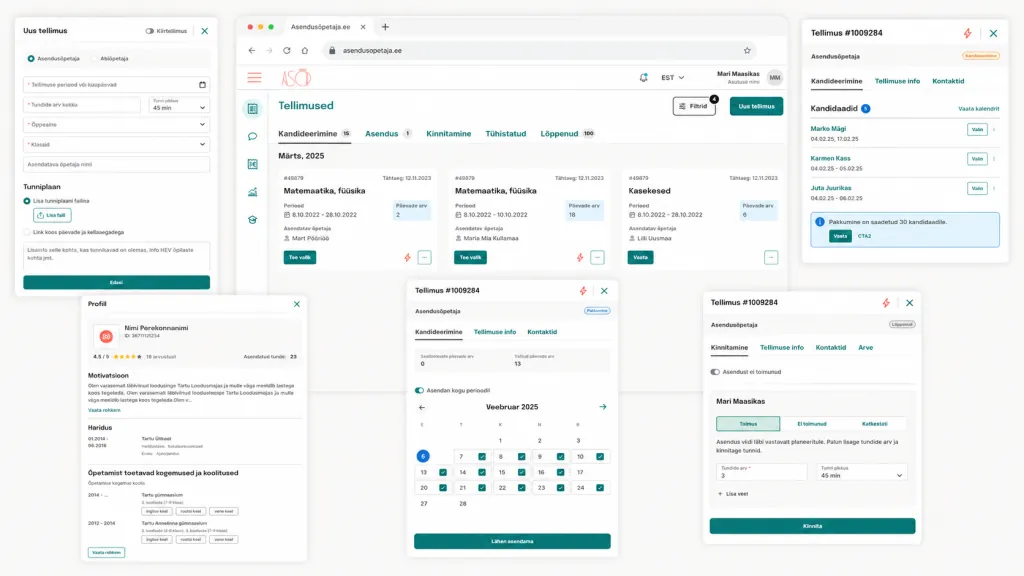
Today the school or kindergarten adds the request and dates on its own, reviews the candidates and picks one. If plans change, it can cancel the request itself. Teachers mark their availability in the calendar and apply.
After the substitution, the lessons are confirmed and the data moves to billing. Notifications go out automatically. What used to be done by hand in a spreadsheet is now handled by the system.
The first version looked nothing like this
We didn’t build everything at once. The first version looked and worked differently from what users see today. Once schools, kindergartens and teachers started using it for real, the feedback came in, and we reworked the onboarding flow and the application process based on it.
Billing, feedback and other parts were added later as separate pieces. Each one went live on its own, so there was never a big, risky switchover.
Technical solution and integrations
The system runs on WordPress with a custom application theme. A designer we worked with shaped the user experience, and Codeteam is responsible for the technical architecture and development. It connects to other systems through integrations: Merit for accounting, Brevo for email, Smart-ID for login and X-tee for Estonian government registries.
Erkky also used ASÕP as an example in an article on using WordPress as a business tool (Veebimajutus.ee blog, in Estonian).
Kasvuprogramm is growing the same way
Kasvuprogramm is live and still being developed. It includes mentoring, reflections and AI-assisted workbooks. It lives on the same platform, and we’re building it the same way: one piece at a time, guided by user feedback.
With Erkky, the question is never whether something can be done, only how. He makes complex IT topics simple and easy to understand.